
Unveiling the Power of Nonlinear Dirichlet Forms
Beschreibung
Beginning in the 60s, Rockafellar and others [BR65, Mor63, Roc70a, Roc70b, RW98] introduced and studied multivalued operators and subgradients of convex functionals. In fact, it is easy to show that t ...
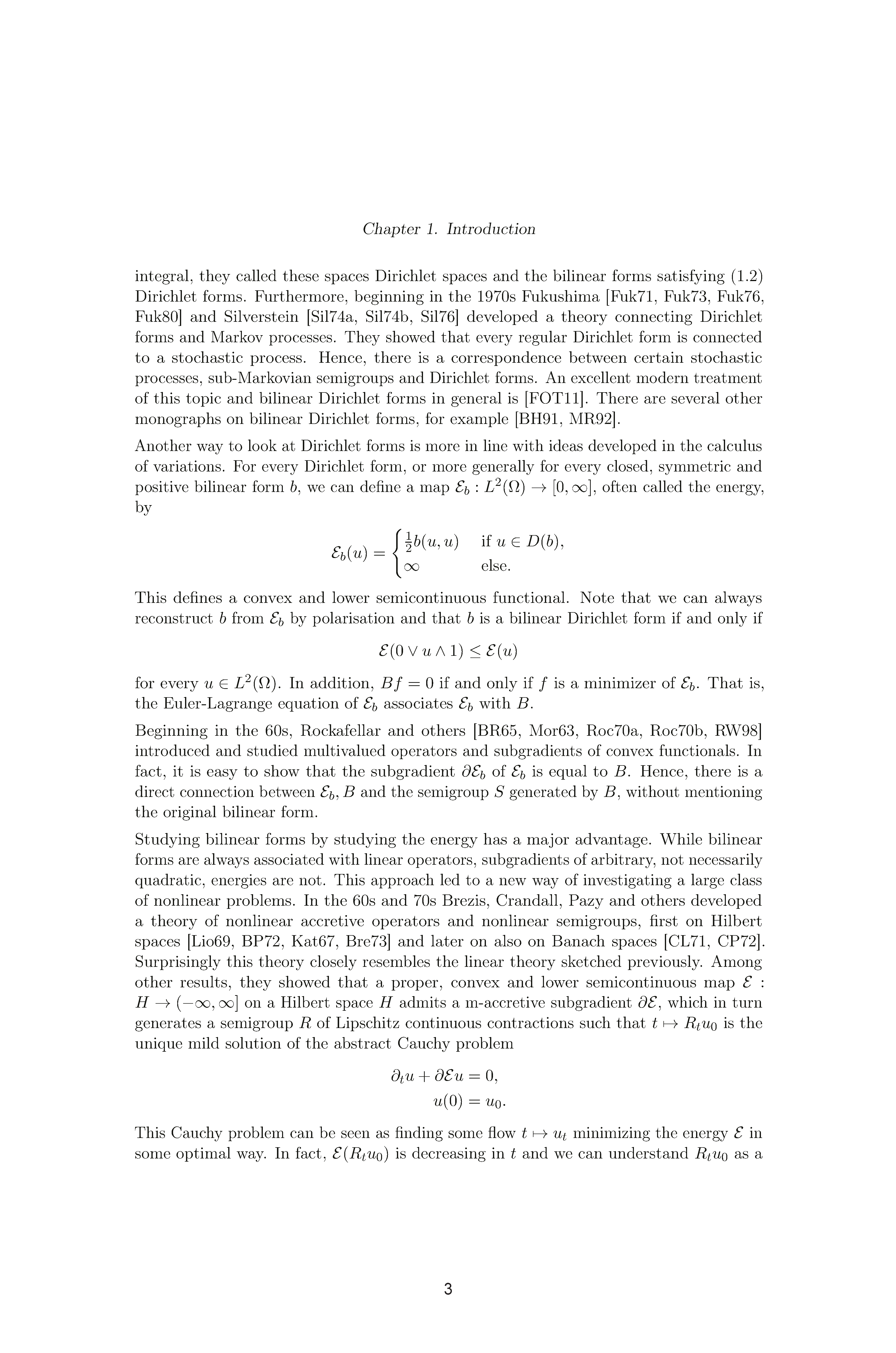
Beginning in the 60s, Rockafellar and others [BR65, Mor63, Roc70a, Roc70b, RW98] introduced and studied multivalued operators and subgradients of convex functionals. In fact, it is easy to show that the subgradient ∂Eb of Eb is equal to B. Hence, there is a direct connection between Eb,B and the semigroup S generated by B, without mentioning the original bilinear form.
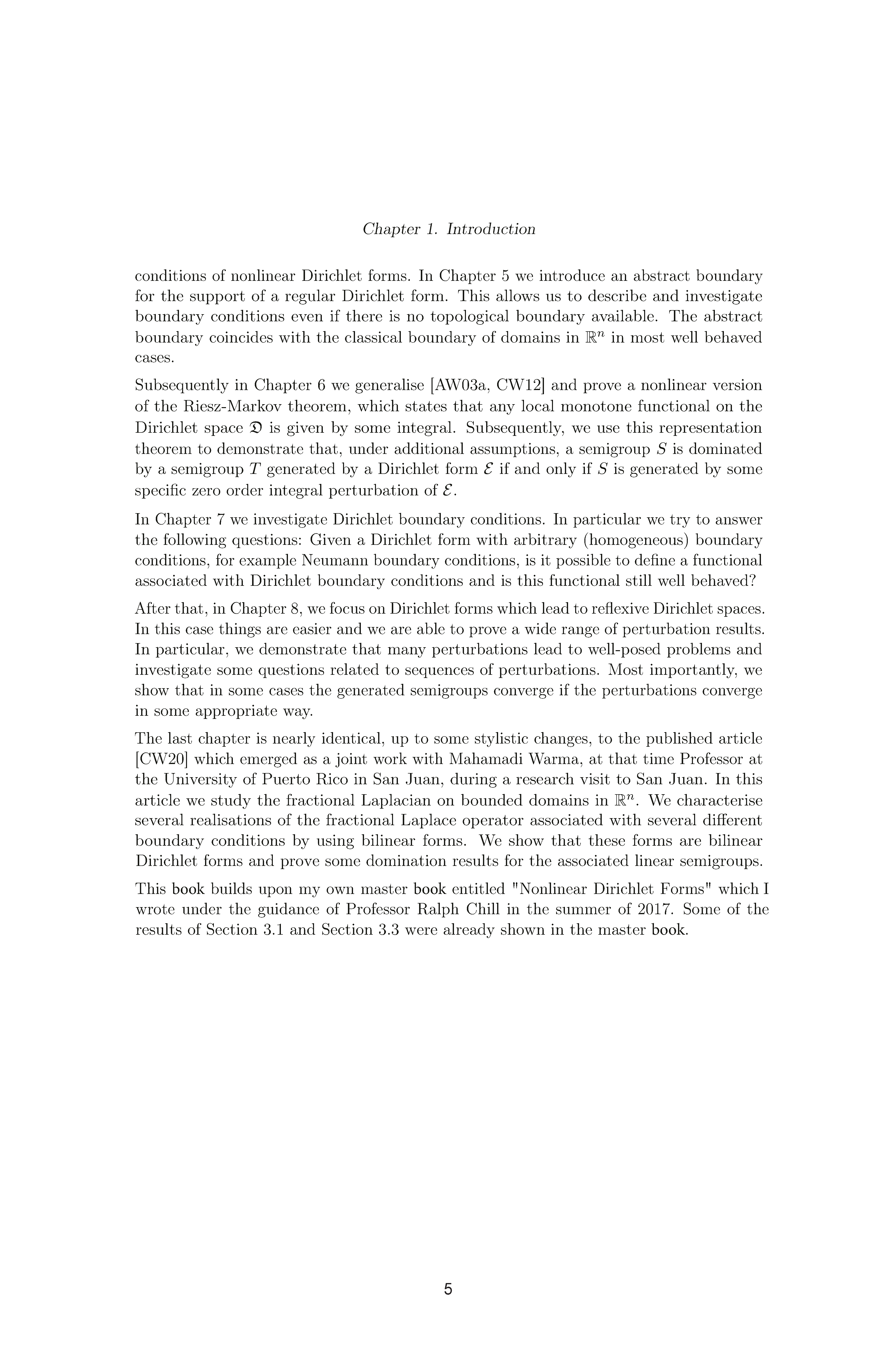
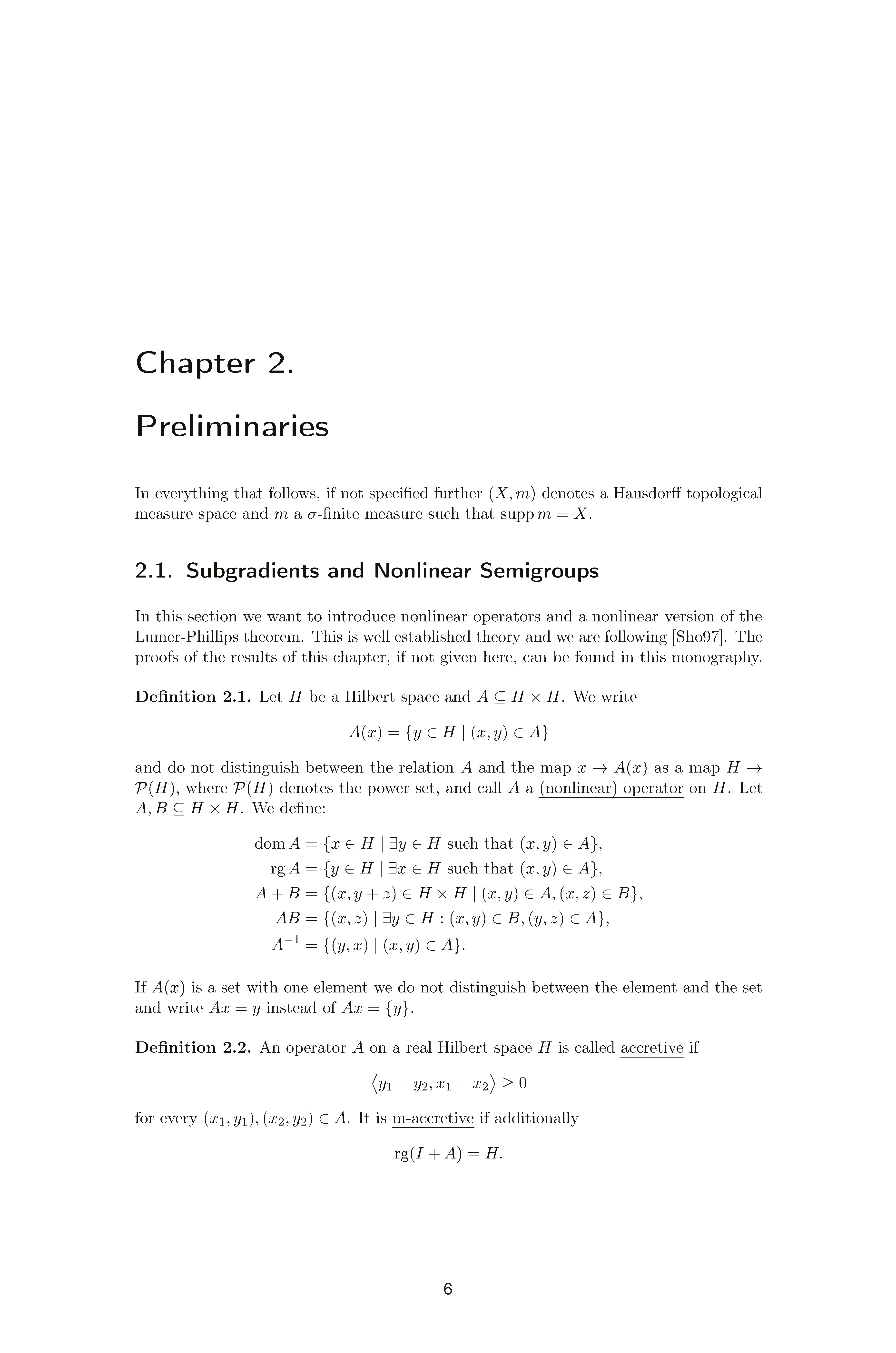
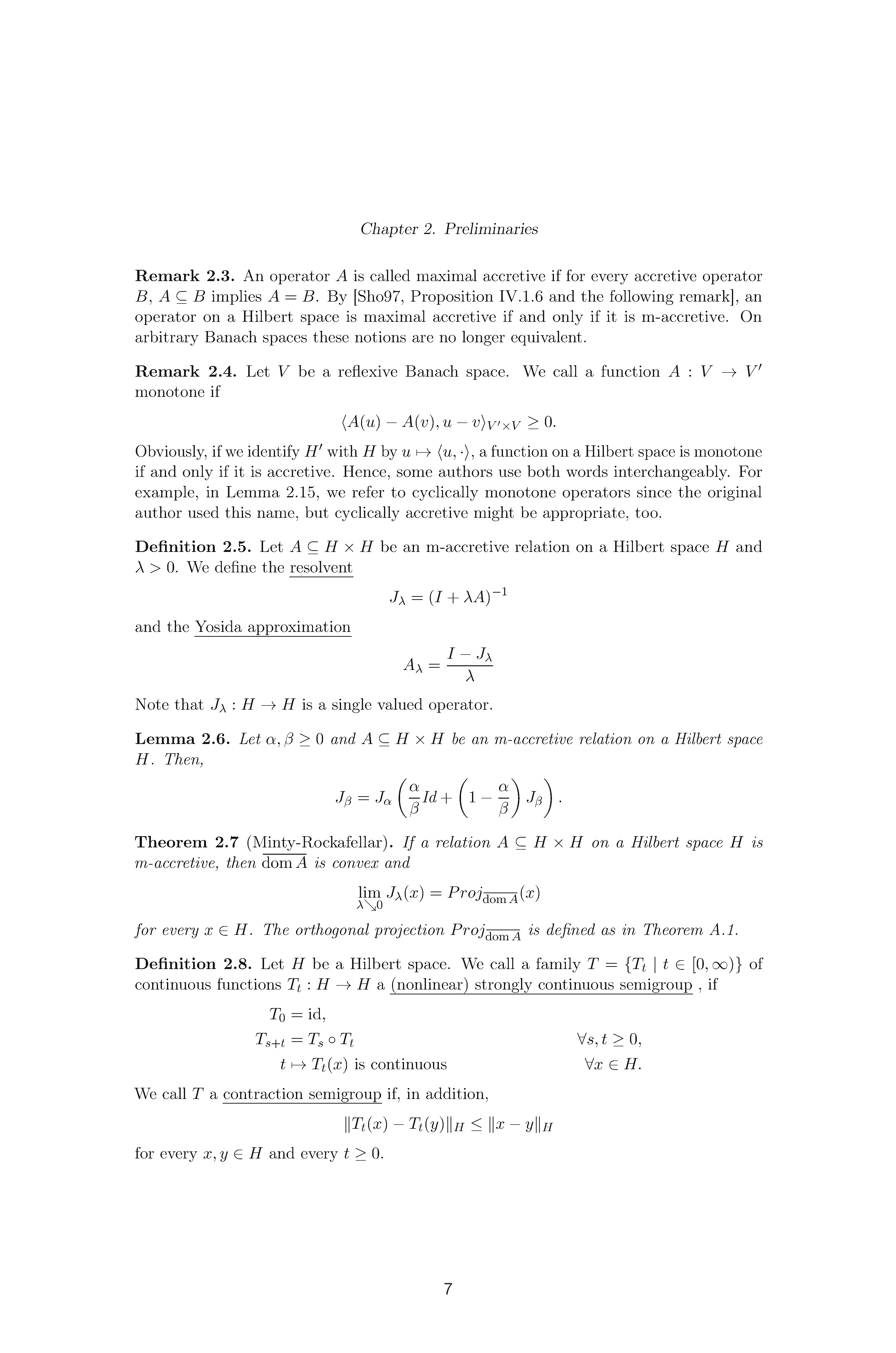
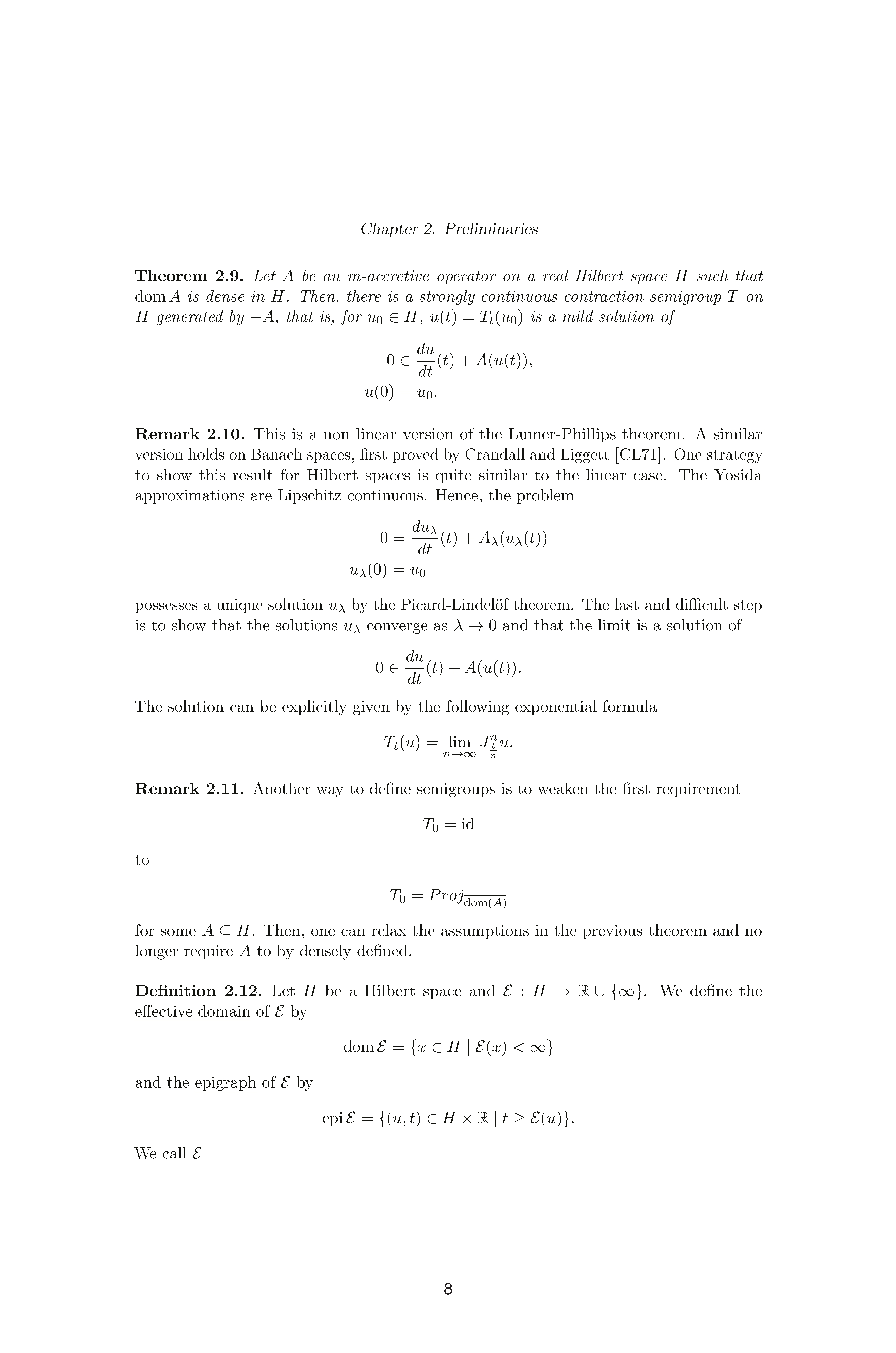
Studying bilinear forms by studying the energy has a major advantage. While bilinear forms are always associated with linear operators, subgradients of arbitrary, not necessarily quadratic, energies are not. This approach led to a new way of investigating a large class of nonlinear problems. In the 60s and 70s Brezis, Crandall, Pazy and others developed a theory of nonlinear accretive operators and nonlinear semigroups, first on Hilbert spaces [Lio69, BP72, Kat67, Bre73] and later on also on Banach spaces [CL71, CP72]. Surprisingly this theory closely resembles the linear theory sketched previously. Among other results, they showed that a proper, convex and lower semicontinuous map E : H → (−∞, ∞] on a Hilbert space H admits a m-accretive subgradient ∂E, which in turn generates a semigroup R of Lipschitz continuous contractions such that t → Rtu0 is the unique mild solution of the abstract Cauchy problem
∂tu + ∂Eu =0,
Details
- Auflage: 0
- Veröffentlichungsdatum: 08.06.2024
- Von Class
- Sprache: Englisch
- ISBN: 978-3-384-25467-2
- Seiten: 172
- Maße und Beschnitt: 15,5 x 23,4 cm
- Gewicht: 298,9g
- Produktionszeit: 5 Werktage

Das könnte dir auch gefallen
-
 Ueber die Erhaltung der Kraft
 -
 Side-Lights on Astronomy and Kindred Fields of Popular Science
 -
 The Advance of Science in the Last Half-Century
 -
 Pleasures of the telescope An Illustrated Guide for Amateur Astronomers and a Popular Description of the Chief Wonders of the Heavens for General Readers
 -
 Elements of Chemistry, In a New Systematic Order, Containing all the Modern Discoveries
 -
 Observations Géologiques sur les Îles Volcaniques
 -
 An Introduction to Chemical Science
 -
 The Birth-Time of the World and Other Scientific Essays
 -
 Ancient and Modern Physics
 -
 An Introduction to Chemical Science
 -
 Insects and Diseases A Popular Account of the Way in Which Insects may Spread or Cause some of our Common Diseases
 -
 The Story of Alchemy and the Beginnings of Chemistry
 -
 The Number Concept Its Origin and Development
 -
 An Elementary Study of Chemistry
 -
 The Number Concept Its Origin and Development
 -
 An Elementary Study of Chemistry
 -
 How it Works Dealing in simple language with steam, electricity, light, heat, sound, hydraulics, optics, etc.
 -
 An Introductory Course of Quantitative Chemical Analysis With Explanatory Notes
 -
 The Elements of Bacteriological Technique A Laboratory Guide for Medical, Dental, and Technical Students. Second Edition Rewritten and Enlarged.
 -
 An Introductory Course of Quantitative Chemical Analysis With Explanatory Notes
